
Leg Pain and Vascular Institute

Five months from invisible to three hundred patients a month

Vascular Website, Google Ads, Meta Ads, Local SEO April to August 2026

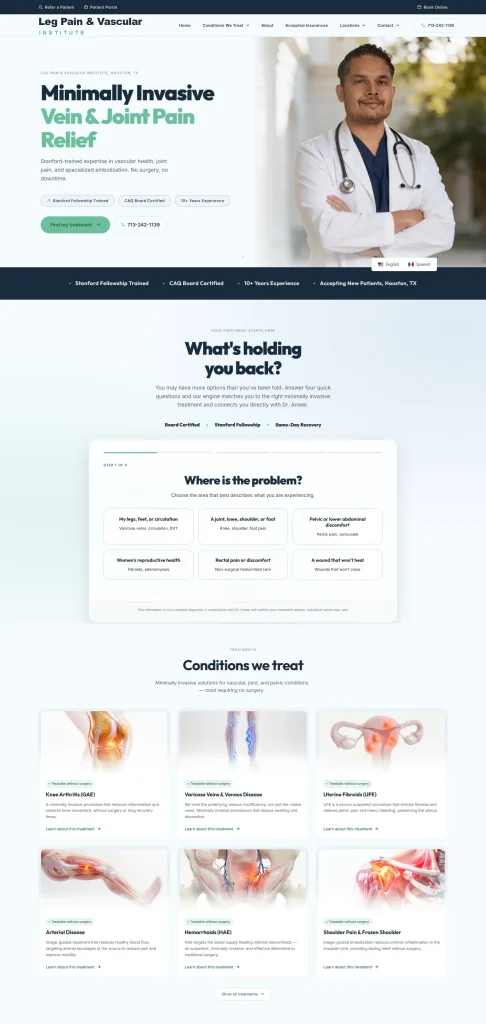
A Houston vascular practice with real expertise and almost no way for patients to find it. Search brought the website fifty visits in seven months. We rebuilt the site, built a patient qualification engine the practice now owns, and launched both ad channels from zero. August brought 806 organic visits and more than three hundred enquiries.

1,466 Patient enquiries in five months
4x More budget, same cost per enquiry
806 Organic visits in August, from almost none before
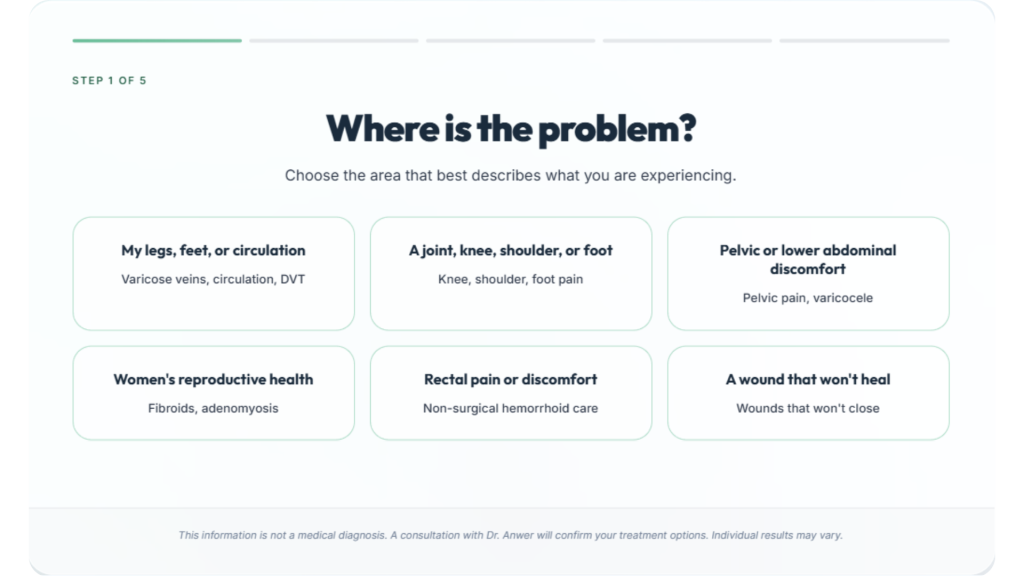
Custom Patient generation and qualification AI engine, built for LPVI
The account

Here is the trap this practice was in, and it catches most specialist clinics.

A patient with knee arthritis has been told two things: take something for the pain, or have the joint replaced. Nobody has mentioned that an image guided procedure exists, that it takes an afternoon, and that they can drive home afterwards. A woman with fibroids has been offered surgery. She has not been offered embolization.

So the patient never types the words. They search their symptom, not the treatment, and a website organised around procedures answers a question they do not know how to ask.

The numbers said the rest. In the seven months before we started, search sent the entire website fifty visits. Not fifty a month. Fifty, total.

This was never a budget problem. You cannot bid on a keyword nobody types, and you cannot rank for a question nobody thinks to ask.

The work

Build around the patient's problem, not the practice's services

Five moves, in the order they happened.

Step 01 of 05
01

The website came first

Sending paid traffic to a weak site is paying to teach people to leave. We rebuilt it around the conditions the practice treats and the questions patients ask before they book, rather than around credentials and procedure names. A site organised by what the practice offers asks the patient to already know what they need. A site organised by symptoms meets them where they are. That one decision is why both the advertising and the organic work had something to stand on.

02

Then the custom AI engine

A patient who cannot name their condition cannot pick a procedure from a list, so we built something that does the picking for them. Someone describes their symptoms and their situation, and it works out which of the practice's procedures fits, then routes them accordingly. It is proprietary to the practice and runs at almost no cost. It earns its place twice over: it brings in patients who had no way in before, and it qualifies them on the way through, so by the time an appointment is booked both sides already know roughly what the consultation is about.

03

Two conditions first, then ten

We launched narrow and deliberately, with knee arthritis and varicose veins on both channels. The question was never which platform performs. It was which problems a patient will raise with a practice they have never met. Both answered inside a month, which told us the condition was the unit that mattered, not the channel or the creative. So we built one campaign covering five conditions at once, with a separate form behind each. Ten conditions have their own now, because somebody with fibroids and somebody with heel pain should never meet the same set of questions.

04

Then the second language

Houston is bilingual. The practice is bilingual. The advertising was not. Spanish campaigns launched with their own forms rather than translated ones, because a translated form still asks the questions an English speaker was expected to answer. They brought patients in at the same cost as the English campaigns, which is the answer to anyone who assumes a second language is a smaller audience rather than an underserved one.

05

Organic ran alongside, not after

Paid media is rented, and it stops the day the paid campaigns do. Most agencies treat search as a later phase, once the ads are working. We built the condition pages to be found from the start, so the same work that made the advertising convert also put the practice in front of somebody searching their symptom at two in the morning with no intention of clicking an advert. Five months in, that channel now brings more traffic than everything we pay for combined.

Outcome

Fifty visits in seven months, then eight hundred in one

Paid

1,466

Patient enquiries in five months, from a standing start in April.

Monthly volume climbed from 87 in April to 364 in August. Cost per enquiry on Meta held under eleven dollars throughout.

Ten conditions, each with its own funnel, across two languages.

Scaling

$9.54 to $10.65

The practice grew its monthly investment more than fivefold across those five months, and the cost of a patient barely moved.

Scaling normally makes an account more expensive, because the cheapest audience gets used up first. This one did not.

Organic

806

Organic visits in August, up from fifty across the seven months before we started. 3,330 in total across the five months.

Organic now brings more traffic than every paid channel combined, and Google organic delivers twice what Google paid does.

Custom

AI engine

It turns somebody who cannot name their condition into a booked, pre-qualified consultation.

Patients arrive knowing what is likely and why. Doctors know before anyone sits down. For a specialist practice that beats another enquiry, because it changes what the appointment is.

Paid, over the first five months:

  • 1,466 patient enquiries from a standing start in April
  • Monthly volume climbed from 87 in April to 364 in August
  • Cost per enquiry on Meta held under eleven dollars throughout
  • Ten conditions, each with its own funnel, across two languages

The hard part. The practice grew its monthly investment more than fivefold across those five months. Over the same stretch the cost of a patient enquiry on Meta moved from $9.54 to $10.65. Scaling normally makes an account more expensive, because the cheapest audience gets used up first. This one barely moved.

Organic, over the same period:

  • 806 visits in August, up from fifty across the seven months before we started
  • 3,330 organic visits in total across the five months
  • Organic now brings more traffic than every paid channel combined
  • Google organic delivers twice what Google paid does

Sit with that last pair. Five months after launch the channel nobody is paying for is out-delivering the one that gets invoiced. Paid bought patients immediately, which is what paid is for. The site and the search work built something that keeps producing whether the budget does or not.

And the practice owns an engine no competitor has. It turns somebody who cannot name their condition into a booked, pre-qualified consultation. Patients arrive knowing what is likely and why. Doctors know before anyone sits down. For a specialist practice that beats another enquiry, because it changes what the appointment is.

The site is also starting to surface in AI assistants. ChatGPT, Claude, Perplexity, Copilot and Gemini all appear in referrals. Small numbers so far, and the direction patient search is heading.

Start here

See what your budget can actually buy.

Model your campaign before you commit a dollar, or send us the account and we will tell you what we would change first.